Complete Guide to Laboratory Equipment With Testing Technology And Instruments
Laboratory equipment plays a critical role in scientific testing, industrial quality control, research, product development, and manufacturing verification. Modern laboratories rely on advanced instruments to analyze materials, measure physical and chemical properties, validate production quality, and support accurate decision-making throughout industrial processes. Laboratory equipment ranges from analytical instruments and measuring devices to sample preparation systems, testing machines, microscopes, balances, environmental chambers, and automated laboratory systems. Together, these technologies help ensure reliable testing results while supporting consistent manufacturing standards.
According to global industrial research, laboratory technology continues to advance through intelligent automation, digital data acquisition, artificial intelligence-assisted analysis, robotic sample handling, cloud-based laboratory management, and precision sensor technology. These innovations improve testing accuracy, reduce human error, accelerate analytical processes, and enhance laboratory efficiency. Modern laboratories increasingly integrate automated instruments with digital management platforms to improve traceability, reporting, and quality assurance across manufacturing and research environments.
Understanding laboratory equipment helps engineers, laboratory technicians, quality control professionals, manufacturing specialists, researchers, educators, and industrial managers appreciate the importance of reliable testing technology. Learning about equipment categories, operating principles, maintenance practices, and industrial applications provides valuable knowledge about one of the most essential components supporting modern science and manufacturing.
Importance Of Laboratory Equipment
Laboratory equipment supports accurate testing throughout manufacturing, pharmaceuticals, food processing, environmental monitoring, chemical production, electronics, construction materials, healthcare, biotechnology, and industrial engineering. Reliable testing allows organizations to verify product quality, evaluate raw materials, monitor production consistency, and identify potential defects before products reach final processing stages.
Modern laboratories improve production reliability by providing measurable data instead of visual estimation. Precision instruments help detect small variations that could affect product performance, manufacturing consistency, or operational safety. Accurate laboratory analysis also supports process optimization by providing continuous feedback for engineering improvements.
Engineering Insight:
Laboratory specialists frequently observe that consistent sample preparation contributes as much to testing accuracy as the instrument itself. Proper sampling procedures, controlled environmental conditions, and standardized operating methods generally produce more reliable analytical results than equipment upgrades alone.
Recent Developments In Laboratory Technology
Recent technological developments have significantly improved laboratory performance. Automated sample preparation systems reduce manual handling while increasing testing consistency across multiple analytical procedures.
Digital laboratory instruments continuously record measurements, environmental conditions, calibration history, operator information, and testing parameters. Integrated laboratory information management systems organize analytical data while improving reporting efficiency and traceability.
Artificial intelligence and machine learning technologies also support laboratory operations by identifying measurement trends, predicting equipment maintenance requirements, assisting quality analysis, and improving decision-making throughout industrial testing environments.
Laboratory Equipment Comparison
| Equipment Type | Primary Function | Common Industrial Application |
|---|---|---|
| Analytical Balance | Precision weighing | Research Laboratories |
| Microscope | Sample examination | Material Analysis |
| Spectrophotometer | Optical measurement | Chemical Testing |
| Laboratory Centrifuge | Sample separation | Biotechnology |
| Environmental Chamber | Controlled testing | Product Development |
| pH Meter | Acidity measurement | Water and Chemical Analysis |
Each laboratory instrument performs a specialized analytical function. Analytical balances provide precise measurements, microscopes reveal microscopic structures, spectrophotometers analyze light absorption, centrifuges separate materials, environmental chambers simulate operating conditions, and pH meters evaluate chemical characteristics.
Working Process And Testing Technology
Laboratory testing begins with sample collection and preparation. Materials are carefully identified, documented, and prepared according to standardized testing procedures before analysis begins. Proper sample preparation minimizes contamination while improving testing reliability.
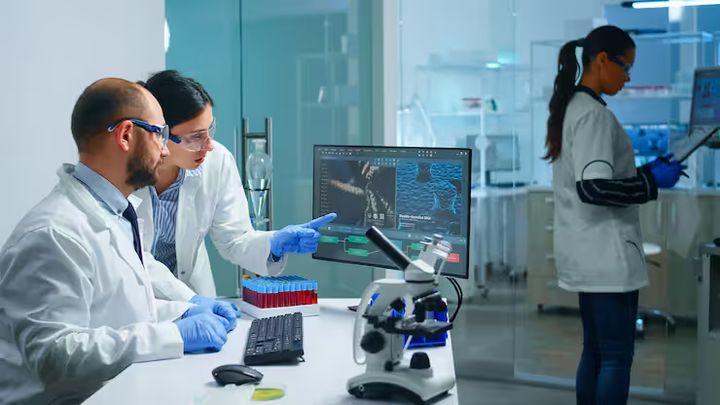
Prepared samples move to specialized laboratory instruments depending on the required analysis. Measuring devices evaluate dimensions, balances determine mass, microscopes examine structural features, spectrophotometers analyze optical properties, and environmental chambers simulate controlled operating conditions. Each instrument generates measurement data based on carefully calibrated operating parameters.
Modern laboratory equipment utilizes digital control systems to regulate temperature, pressure, humidity, optical performance, measurement sensitivity, and analytical timing. Automated software records testing information while minimizing manual calculation errors and improving result consistency.
Practical Engineering Observation:
Laboratory performance evaluations frequently demonstrate that routine instrument calibration has a greater impact on testing accuracy than increasing equipment complexity. Well-maintained instruments operating under standardized procedures generally produce more reliable analytical data than advanced systems with inconsistent calibration.
Quality assurance remains essential throughout laboratory operations. Calibration verification, reference materials, instrument validation, repeatability testing, and routine performance checks help maintain measurement accuracy while supporting reliable industrial analysis.
Preventive maintenance also contributes significantly to equipment reliability. Regular inspection of sensors, optics, electronic components, moving mechanisms, calibration standards, software systems, environmental controls, and safety equipment helps preserve analytical performance while reducing unexpected equipment downtime.
Industrial Applications
Laboratory equipment supports pharmaceutical manufacturing, food processing, chemical production, electronics manufacturing, construction materials, environmental testing, biotechnology, automotive engineering, metallurgy, plastics processing, renewable energy, and industrial quality control.
Manufacturing facilities utilize laboratory instruments to inspect incoming raw materials, monitor production processes, verify finished product quality, and evaluate long-term performance characteristics. Pharmaceutical laboratories depend on analytical instruments for formulation development, ingredient verification, stability studies, and quality assurance.
Food processing laboratories perform nutritional analysis, ingredient testing, contamination monitoring, and product verification. Construction material laboratories evaluate concrete, aggregates, asphalt, coatings, insulation materials, and structural products. Electronics manufacturers use laboratory testing for component validation, material analysis, reliability testing, and product development across precision manufacturing environments.
Professional Insight:
Successful laboratory operations depend on integrating reliable instruments with standardized testing procedures, preventive maintenance, quality assurance systems, digital data management, and continuous calibration. Together, these factors provide consistent analytical performance while supporting industrial manufacturing and scientific research.
Frequently Asked Questions
What is laboratory equipment?
Laboratory equipment includes scientific instruments and testing devices used to measure, analyze, inspect, prepare, and evaluate materials for research, manufacturing, quality control, and industrial applications.
What are the main types of laboratory equipment?
Common laboratory equipment includes analytical balances, microscopes, spectrophotometers, centrifuges, environmental chambers, pH meters, testing machines, incubators, laboratory ovens, and precision measuring instruments.
How does laboratory equipment work?
Laboratory instruments measure physical, chemical, optical, thermal, or mechanical properties using calibrated sensors, electronic controls, analytical software, and standardized operating procedures to produce accurate testing results.
Which industries commonly use laboratory equipment?
Pharmaceuticals, food processing, chemicals, biotechnology, construction materials, electronics, automotive engineering, environmental testing, plastics manufacturing, metallurgy, and industrial quality control widely use laboratory equipment.
Why is preventive maintenance important?
Routine maintenance preserves measurement accuracy, extends instrument lifespan, supports calibration reliability, minimizes testing errors, reduces unexpected downtime, and maintains consistent laboratory performance.
Conclusion
Laboratory equipment remains essential for scientific analysis, industrial quality control, research, and manufacturing because it provides accurate measurements, reliable testing, and consistent analytical performance. Advances in automation, digital technology, intelligent software, and precision instrumentation continue improving laboratory efficiency across numerous industries.
From an engineering perspective, successful laboratory operations depend on accurate sample preparation, reliable instrumentation, routine calibration, preventive maintenance, standardized testing procedures, and continuous quality assurance. As laboratory technology continues advancing, modern testing equipment will remain fundamental to product development, industrial manufacturing, research, and scientific innovation.