Industrial Automation Systems Overview With Process Control And Engineering
Industrial automation systems are integrated technologies that use programmable controllers, sensors, actuators, communication networks, software, and intelligent monitoring to operate manufacturing processes with minimal manual intervention. These systems coordinate machinery, production equipment, material handling, and quality inspection while maintaining consistent process performance across industrial facilities. Modern automation combines mechanical engineering, electrical engineering, digital control, industrial networking, and data analysis to improve productivity, operational reliability, and manufacturing efficiency.
According to global engineering research, industrial automation continues to evolve through artificial intelligence-assisted process optimization, Industrial Internet of Things (IIoT) platforms, cloud-based manufacturing systems, machine learning, predictive maintenance, digital twins, collaborative robotics, and advanced industrial communication protocols. These developments improve production consistency, reduce equipment downtime, optimize energy usage, and strengthen operational visibility. Modern manufacturing plants increasingly integrate automation systems with enterprise software to support data-driven production management.
Understanding industrial automation systems helps manufacturing engineers, automation specialists, maintenance professionals, production managers, plant operators, and engineering students appreciate the importance of intelligent process control. Learning about automation components, working principles, maintenance strategies, and industrial applications provides valuable knowledge about one of the most significant technologies driving modern manufacturing.
Importance Of Industrial Automation Systems
Industrial automation systems support manufacturing, chemical processing, food production, pharmaceuticals, automotive manufacturing, electronics assembly, mining, power generation, renewable energy, water treatment, logistics, and packaging industries. These sectors depend on automation to improve production accuracy, maintain product quality, and increase operational efficiency.
Automated systems reduce repetitive manual tasks while allowing continuous monitoring of production equipment and process conditions. Intelligent process control also improves consistency by automatically adjusting machine operations according to changing production requirements.
Engineering Insight:
Automation engineers frequently observe that well-designed control logic contributes more to long-term production reliability than increasing processing speed. Stable automation strategies generally improve manufacturing efficiency while reducing unnecessary equipment stress.
Recent Developments In Industrial Automation Technology
Modern automation technology has advanced through programmable automation controllers, intelligent sensors, industrial robots, digital twins, machine vision inspection, cloud computing, wireless industrial communication, and artificial intelligence-assisted production management. These technologies improve manufacturing flexibility while supporting real-time operational analysis.
Smart monitoring systems continuously evaluate equipment status, production performance, process variables, energy consumption, maintenance conditions, and product quality. Predictive maintenance software analyzes operational data to identify servicing requirements before unexpected equipment failures occur.
Industrial connectivity has also expanded throughout manufacturing facilities. Modern automation systems communicate with enterprise resource planning software, manufacturing execution systems, quality management platforms, maintenance applications, and supply chain software to improve coordination across industrial operations.
Industrial Automation System Comparison
| Automation Component | Primary Function | Common Industrial Application |
|---|---|---|
| Programmable Logic Controller | Machine control | Manufacturing Plants |
| Human Machine Interface | Operator interaction | Process Industries |
| Industrial Sensors | Process monitoring | Automated Production |
| Servo Drive System | Precision motion control | Robotics |
| Variable Frequency Drive | Motor speed regulation | Material Handling |
| Supervisory Control System | Centralized monitoring | Utility Operations |
Each automation component performs a specialized role. Programmable logic controllers coordinate machine operations, human-machine interfaces provide operator control, sensors monitor process conditions, servo drives deliver precise motion, variable frequency drives regulate motors, and supervisory systems oversee complete industrial processes.
Working Process And Process Control Technology
Industrial automation begins when sensors continuously collect information from machinery and production equipment. Parameters such as pressure, temperature, position, speed, flow rate, vibration, level, and electrical signals are measured and transmitted to programmable control systems.
Programmable logic controllers or industrial controllers analyze incoming information according to predefined control programs developed for the manufacturing process. Based on operating conditions, the controller automatically issues commands to actuators, motors, valves, robotic systems, conveyors, or other equipment to maintain stable production.
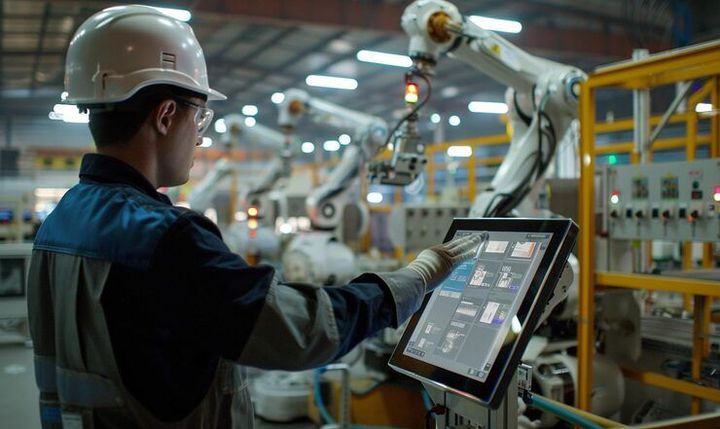
Human-machine interfaces provide operators with real-time information regarding equipment status, production data, alarms, maintenance notifications, and operational trends. Operators can supervise manufacturing processes while making authorized adjustments when production requirements change.
Practical Engineering Observation:
Manufacturing evaluations frequently demonstrate that accurate sensor calibration significantly improves automation performance. Reliable process measurements generally contribute more to stable production than increasing controller processing speed.
Industrial communication networks transfer information between controllers, sensors, field devices, monitoring systems, and enterprise software throughout the facility. Continuous data exchange allows production managers to evaluate equipment performance, monitor energy consumption, analyze production efficiency, and optimize maintenance planning.
Routine preventive maintenance remains essential for reliable automation performance. Regular inspection of programmable controllers, sensors, actuators, communication cables, electrical panels, drives, motors, control software, safety devices, and network infrastructure helps maintain operational reliability while reducing unexpected production interruptions. Scheduled software updates and calibration further support consistent automation performance.
Industrial Applications
Industrial automation systems support automotive manufacturing, electronics production, food processing, pharmaceutical manufacturing, chemical processing, mining, renewable energy, water treatment, packaging, logistics, material handling, and industrial machinery.
Automotive production facilities utilize automation to coordinate robotic welding, assembly operations, painting, quality inspection, and material handling throughout vehicle manufacturing. Food manufacturers rely on automated systems to control processing, packaging, labeling, and product inspection while maintaining consistent production quality.
Chemical processing plants use automation for process control, pressure regulation, temperature management, and production monitoring. Pharmaceutical manufacturers depend on precise automation for controlled production environments, while logistics centers utilize automated conveyors, sorting systems, and warehouse management technologies. Renewable energy facilities, mining operations, and water treatment plants also rely on intelligent automation to improve operational efficiency.
Professional Insight:
Successful industrial automation depends on integrating process control, sensor technology, communication networks, preventive maintenance, software management, quality monitoring, and operator training into one coordinated manufacturing strategy. Balanced automation design generally improves long-term production performance more effectively than increasing system complexity alone.
Frequently Asked Questions
What are industrial automation systems?
Industrial automation systems are integrated technologies that automatically monitor and control machinery, manufacturing processes, and production equipment using intelligent control systems and industrial software.
What are the main components of industrial automation?
Major components include programmable logic controllers, industrial sensors, human-machine interfaces, servo drives, variable frequency drives, communication networks, supervisory control systems, and automation software.
How do industrial automation systems work?
Sensors collect process information, controllers analyze operating conditions, automation software issues control commands, and actuators perform machine movements while monitoring systems continuously supervise production performance.
Which industries commonly use industrial automation systems?
Manufacturing, automotive production, food processing, pharmaceuticals, chemical processing, mining, logistics, renewable energy, water treatment, electronics manufacturing, and packaging widely use industrial automation.
Why is preventive maintenance important?
Routine maintenance improves automation reliability, extends equipment lifespan, reduces unexpected downtime, preserves control accuracy, supports continuous production, and maintains efficient industrial operation.
Conclusion
Industrial automation systems remain fundamental to modern manufacturing because they provide intelligent process control, reliable production management, efficient equipment coordination, and dependable operational performance across numerous engineering industries. Advances in artificial intelligence, Industrial Internet of Things technologies, cloud connectivity, predictive maintenance, and digital manufacturing continue transforming industrial automation.
From an engineering perspective, successful automation depends on proper system design, accurate process control, preventive maintenance, continuous monitoring, reliable communication networks, and effective software management. As industrial technology continues advancing, industrial automation systems will remain essential for improving manufacturing efficiency, operational reliability, and smart industrial production.