Understanding Industrial Hoses With Fluid Transfer Technology And Equipment
Industrial hoses are flexible engineered components designed to safely transport liquids, gases, steam, chemicals, air, abrasive materials, and other process media between industrial equipment and processing systems. They are widely used because they provide flexibility, vibration absorption, pressure resistance, and reliable fluid movement in applications where rigid piping is impractical. Modern industrial hoses combine advanced elastomers, thermoplastics, reinforced textiles, steel wire braiding, composite materials, and precision manufacturing technology to deliver dependable performance under demanding operating conditions.
According to global engineering research, industrial hose technology continues to evolve through high-performance reinforcement materials, abrasion-resistant compounds, intelligent condition monitoring, advanced coupling systems, digital inspection methods, and predictive maintenance solutions. These developments improve service life, increase operational safety, reduce maintenance requirements, and enhance overall process reliability. Manufacturers increasingly design hose systems capable of operating under higher pressures, wider temperature ranges, and more demanding industrial environments.
Understanding industrial hoses helps mechanical engineers, maintenance professionals, plant operators, production managers, construction specialists, and engineering students appreciate the importance of safe fluid transfer technology. Learning about hose construction, working principles, maintenance practices, and industrial applications provides valuable knowledge about one of the most essential components supporting industrial operations.
Importance Of Industrial Hoses
Industrial hoses support manufacturing facilities, construction sites, mining operations, agriculture, chemical processing, food production, pharmaceuticals, oil and gas operations, marine engineering, water treatment, and industrial machinery. These industries rely on dependable hose systems for transferring fluids efficiently while maintaining operational safety and production continuity.
Flexible hose systems simplify equipment installation by accommodating movement, vibration, thermal expansion, and temporary connections that rigid piping cannot easily provide. Proper hose selection also contributes to improved equipment protection by reducing stress on pumps, valves, compressors, and hydraulic systems.
Engineering Insight:
Maintenance engineers frequently observe that selecting the correct hose material for the operating fluid contributes more to service life than increasing pressure capacity alone. Material compatibility generally has a significant influence on long-term hose performance.
Recent Developments In Hose Technology
Modern industrial hose technology has advanced through lightweight composite reinforcement, high-strength synthetic fibers, intelligent leak detection, digital identification systems, automated manufacturing, and advanced hose testing methods. These innovations improve durability while supporting more efficient industrial operations.
Smart monitoring systems now evaluate hose pressure, temperature, vibration, flow conditions, and service history. Predictive maintenance software analyzes operating data to identify replacement requirements before hose performance declines or unexpected failures occur.
Industrial connectivity has also expanded throughout fluid handling systems. Modern hose assemblies communicate with process monitoring platforms, maintenance software, equipment management systems, and inspection databases to improve operational visibility while supporting preventive maintenance programs.
Industrial Hose Comparison
| Hose Type | Primary Advantage | Common Industrial Application |
|---|---|---|
| Hydraulic Hose | High-pressure performance | Hydraulic Machinery |
| Chemical Hose | Chemical resistance | Processing Plants |
| Air Hose | Flexible compressed air transfer | Manufacturing Facilities |
| Water Hose | Reliable water transport | Construction Sites |
| Steam Hose | High-temperature operation | Industrial Boilers |
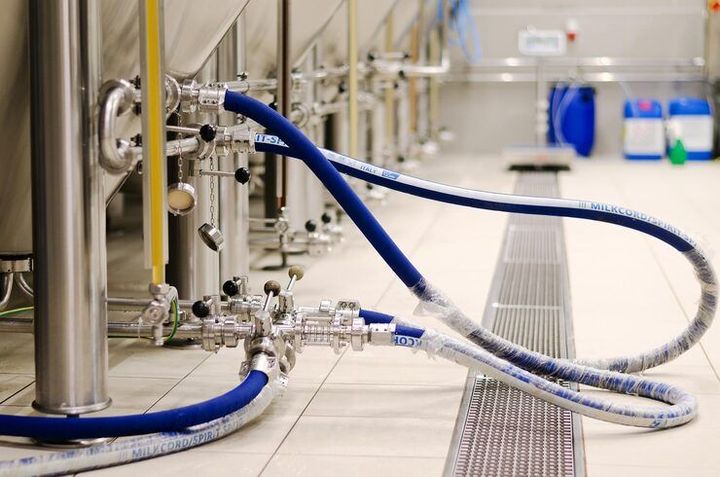
| Food Grade Hose | Hygienic fluid handling | Food Manufacturing |
Each hose supports different operational requirements. Hydraulic hoses handle high-pressure systems, chemical hoses resist aggressive process fluids, air hoses supply compressed air, water hoses support fluid distribution, steam hoses withstand elevated temperatures, and food-grade hoses maintain hygienic processing conditions.
Working Process And Fluid Transfer Technology
Industrial hose operation begins by connecting the hose assembly between equipment using properly matched couplings, fittings, clamps, or quick-connect systems. Secure connections help maintain leak-free operation while ensuring safe fluid transfer throughout industrial processes.
During operation, pumps, compressors, hydraulic systems, or process pressure move fluids through the hose assembly. Reinforcement layers within the hose resist internal pressure while flexible outer materials accommodate movement, bending, vibration, and environmental exposure without compromising structural integrity.
Modern industrial hose assemblies utilize multiple engineered layers that perform different functions. The inner tube provides chemical compatibility with transported media, reinforcement layers withstand operating pressure, and the outer cover protects against abrasion, weather, ultraviolet exposure, oils, and mechanical damage.
Practical Engineering Observation:
Industrial maintenance evaluations frequently demonstrate that maintaining proper hose bend radius significantly improves service life. Excessive bending near fittings often increases mechanical stress, leading to premature wear and reduced operational reliability.
Depending on the application, hose systems may transport hydraulic oil, compressed air, cooling water, steam, chemicals, fuel, food products, slurry, or other industrial fluids. Continuous monitoring of operating pressure, temperature, and flow conditions helps maintain safe and efficient operation throughout production.
Routine preventive maintenance remains essential for reliable hose performance. Regular inspection of hose covers, reinforcement layers, couplings, clamps, seals, fittings, pressure ratings, wear points, and fluid compatibility helps identify deterioration before leakage or failure occurs. Scheduled hose replacement according to operating conditions further supports equipment reliability and workplace safety.
Industrial Applications
Industrial hoses support manufacturing, mining, construction, agriculture, oil and gas, food processing, pharmaceuticals, marine engineering, chemical production, water treatment, renewable energy, and industrial maintenance.
Manufacturing facilities use industrial hoses for compressed air systems, hydraulic equipment, coolant circulation, lubrication systems, and process fluid transfer. Construction sites rely on heavy-duty hoses for concrete placement, water distribution, pneumatic tools, and hydraulic machinery.
Chemical processing facilities require specialized hose materials capable of safely transporting corrosive process fluids. Food manufacturers depend on hygienic hose systems for ingredient handling and product transfer, while mining operations utilize abrasion-resistant hoses for slurry transport. Marine engineering, power generation, renewable energy, and industrial maintenance operations also rely on advanced hose technology to support reliable fluid handling.
Professional Insight:
Successful fluid transfer depends on integrating proper hose selection, compatible fittings, preventive maintenance, operating condition monitoring, routine inspection, and correct installation into one coordinated engineering system. Balanced maintenance practices generally improve hose reliability more effectively than selecting higher pressure ratings alone.
Frequently Asked Questions
What are industrial hoses?
Industrial hoses are flexible engineered tubes used to safely transfer liquids, gases, air, steam, chemicals, and other industrial process media between equipment.
What are the main types of industrial hoses?
Common hose types include hydraulic hoses, chemical hoses, air hoses, water hoses, steam hoses, food-grade hoses, fuel hoses, and slurry transfer hoses.
How do industrial hoses work?
Industrial hoses transport fluids under pressure while reinforced construction provides strength, flexibility, chemical resistance, and protection against mechanical wear and environmental conditions.
Which industries commonly use industrial hoses?
Manufacturing, construction, mining, agriculture, oil and gas, food processing, pharmaceuticals, marine engineering, water treatment, renewable energy, and chemical manufacturing widely use industrial hoses.
Why is preventive maintenance important?
Routine maintenance improves hose reliability, extends service life, reduces unexpected downtime, prevents fluid leakage, protects connected equipment, and supports safe industrial operations.
Conclusion
Industrial hoses remain essential fluid handling components because they provide reliable transportation of liquids, gases, and process media while supporting flexible installation, operational efficiency, and equipment protection across numerous industries. Advances in reinforcement materials, intelligent monitoring, predictive maintenance, and precision manufacturing continue improving hose technology throughout modern industrial systems.
From an engineering perspective, successful hose performance depends on proper material selection, accurate installation, preventive maintenance, routine inspection, operating condition monitoring, and compatible system design. As industrial technology continues advancing, industrial hoses will remain fundamental to safe fluid transfer, dependable equipment performance, and efficient manufacturing operations.