Pressure Transmitter Technology Guide With Industrial Monitoring
Pressure transmitters are precision industrial instruments designed to measure the pressure of liquids, gases, steam, and process fluids, then convert the measured value into standardized electrical signals for monitoring and control systems. They play a critical role in industrial automation by providing accurate pressure measurements that help maintain safe operating conditions, optimize production efficiency, and improve equipment reliability. Modern pressure transmitters combine advanced sensing technology, digital electronics, intelligent diagnostics, and industrial communication protocols to deliver highly accurate and dependable measurements across demanding operating environments.
According to global process engineering research, pressure transmitter technology continues to evolve through smart sensors, wireless communication, digital calibration, artificial intelligence-assisted diagnostics, predictive maintenance software, and cloud-connected monitoring platforms. These innovations improve measurement accuracy, reduce maintenance requirements, increase equipment reliability, and enhance industrial process control. Modern production facilities increasingly integrate pressure transmitters into automated monitoring systems to support real-time operational decision-making.
Understanding pressure transmitters helps instrumentation engineers, maintenance professionals, plant operators, automation specialists, process engineers, and engineering students appreciate the importance of accurate pressure monitoring in industrial operations. Learning about sensor technology, working principles, installation practices, and industrial applications provides valuable knowledge about one of the most essential instruments used in process industries.
Importance Of Pressure Transmitters
Pressure transmitters are widely used in chemical processing, oil and gas operations, power generation, food manufacturing, pharmaceutical production, water treatment, mining, HVAC systems, renewable energy, and industrial automation. These industries rely on continuous pressure measurement to maintain stable process conditions while protecting equipment from excessive pressure or abnormal operating conditions.
Accurate pressure monitoring improves operational safety by allowing operators to identify process variations before equipment performance is affected. Reliable measurement also supports energy efficiency, product consistency, equipment protection, and regulatory compliance throughout industrial production.
Engineering Insight:
Instrumentation engineers frequently observe that proper transmitter installation contributes more to measurement accuracy than sensor sensitivity alone. Correct mounting location, impulse line design, and process connection selection generally improve long-term measurement stability while reducing maintenance requirements.
Recent Developments In Pressure Measurement Technology
Modern pressure transmitter technology has advanced through microelectromechanical sensing elements, digital signal processing, wireless instrumentation, intelligent diagnostics, automatic calibration verification, and predictive maintenance systems. These developments improve measurement precision while simplifying industrial monitoring.
Smart transmitters continuously evaluate sensor condition, process stability, electrical performance, temperature compensation, and communication quality. Predictive maintenance software analyzes operational trends to identify calibration requirements or equipment servicing before measurement accuracy declines.
Industrial connectivity has also expanded throughout automation systems. Modern pressure transmitters communicate with distributed control systems, programmable logic controllers, supervisory monitoring platforms, laboratory systems, and maintenance software to improve process visibility and operational efficiency.
Pressure Transmitter Comparison
| Transmitter Type | Primary Advantage | Common Industrial Application |
|---|---|---|
| Gauge Pressure Transmitter | Measures pressure relative to atmosphere | Hydraulic Systems |
| Absolute Pressure Transmitter | High measurement accuracy | Vacuum Systems |
| Differential Pressure Transmitter | Measures pressure difference | Filtration Equipment |
| Sealed Gauge Transmitter | Stable reference pressure | Process Industries |
| Wireless Pressure Transmitter | Flexible installation | Remote Monitoring |
| Smart Pressure Transmitter | Digital diagnostics | Industrial Automation |
Each transmitter supports different measurement requirements. Gauge transmitters monitor system pressure, absolute transmitters provide reference-independent measurements, differential transmitters evaluate pressure differences, sealed gauge transmitters improve stability, wireless devices simplify installation, and smart transmitters provide advanced diagnostics.
Working Process And Pressure Monitoring Technology
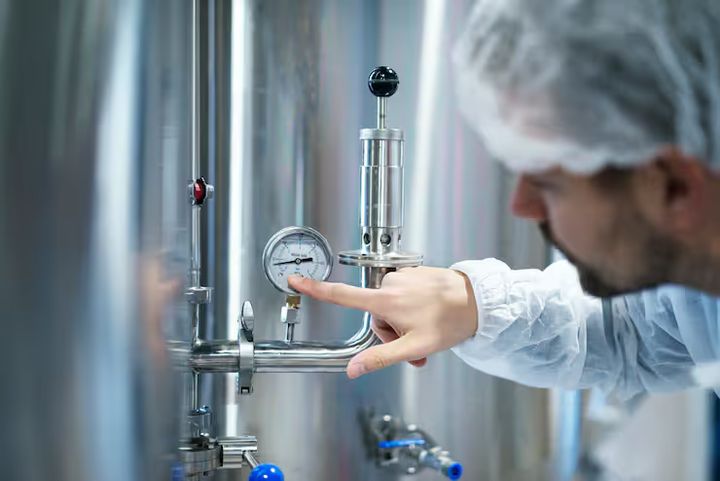
Pressure measurement begins when process fluid enters the pressure transmitter through a specially designed process connection. The applied pressure acts upon a sensing element, such as a diaphragm or pressure sensor, which undergoes a very small mechanical deformation proportional to the applied pressure.
The sensing element converts this mechanical movement into an electrical signal using advanced measurement technologies. Internal electronics amplify, compensate, and process the signal while correcting for environmental influences such as temperature changes. Digital processors continuously improve measurement accuracy before transmitting standardized output signals to industrial control systems.
Modern pressure transmitters commonly provide analog or digital communication outputs that allow real-time monitoring throughout industrial automation systems. Operators receive continuous pressure information through control room displays, supervisory software, or distributed process control platforms where measurements support operational decisions and equipment protection.
Practical Engineering Observation:
Industrial maintenance evaluations frequently demonstrate that routine calibration verification significantly improves long-term measurement reliability. Even high-quality transmitters benefit from periodic inspection to maintain measurement accuracy under changing process conditions.
Pressure information supports automatic process adjustments by controlling pumps, compressors, valves, pressure regulators, and safety systems. Intelligent monitoring also allows engineers to identify gradual process changes before they develop into operational issues.
Routine preventive maintenance remains essential for reliable transmitter performance. Regular inspection of sensing elements, impulse lines, process connections, seals, wiring, electrical terminals, communication modules, mounting hardware, and protective enclosures helps maintain measurement accuracy while reducing unexpected instrument failures. Scheduled calibration further preserves reliable long-term monitoring.
Industrial Applications
Pressure transmitters support chemical manufacturing, oil and gas production, pharmaceutical processing, food manufacturing, power generation, water treatment, renewable energy, mining, HVAC systems, industrial automation, and manufacturing facilities.
Chemical processing plants use pressure transmitters to monitor reactors, pipelines, storage vessels, filtration systems, and processing equipment operating under controlled pressure conditions. Oil and gas facilities depend on continuous pressure measurement throughout drilling equipment, pipelines, compressors, and processing plants.
Water treatment facilities utilize pressure transmitters within pumping stations, filtration systems, distribution networks, and treatment processes. Food manufacturers monitor hygienic processing systems, while pharmaceutical facilities require highly accurate pressure measurements for controlled production environments. Power generation, renewable energy, mining operations, and industrial automation systems also depend on advanced pressure transmitter technology to maintain safe and efficient operation.
Professional Insight:
Successful industrial pressure monitoring depends on integrating correct transmitter selection, professional installation, preventive maintenance, routine calibration, process monitoring, and intelligent diagnostics into one coordinated instrumentation strategy. Consistent measurement practices generally improve long-term operational reliability more effectively than increasing sensor precision alone.
Frequently Asked Questions
What is a pressure transmitter?
A pressure transmitter is an industrial instrument that measures fluid or gas pressure and converts the measurement into standardized electrical signals for monitoring and control systems.
What are the main types of pressure transmitters?
Common transmitter types include gauge pressure transmitters, absolute pressure transmitters, differential pressure transmitters, sealed gauge transmitters, wireless transmitters, and smart digital pressure transmitters.
How does a pressure transmitter work?
A sensing element detects applied pressure, converts mechanical movement into an electrical signal, processes the measurement digitally, and transmits the result to industrial monitoring and control systems.
Which industries commonly use pressure transmitters?
Chemical processing, oil and gas, pharmaceuticals, food manufacturing, power generation, water treatment, mining, HVAC, renewable energy, manufacturing, and industrial automation widely use pressure transmitters.
Why is preventive maintenance important?
Routine maintenance improves measurement accuracy, extends instrument lifespan, reduces unexpected failures, preserves calibration stability, supports reliable process control, and enhances industrial safety.
Conclusion
Pressure transmitters remain essential industrial instruments because they provide accurate pressure measurement, reliable process monitoring, equipment protection, and dependable automation performance across numerous engineering industries. Advances in smart sensing technology, digital communication, predictive diagnostics, and intelligent monitoring continue improving industrial pressure measurement systems.
From an engineering perspective, successful pressure monitoring depends on proper transmitter selection, accurate installation, preventive maintenance, routine calibration, continuous diagnostics, and integrated process control. As industrial automation continues advancing, pressure transmitter technology will remain fundamental to safe operations, efficient production, and reliable industrial process management.